
Is This the Safest Way to Invest My Money?
A two-year Trading212 portfolio is up across the board — but with 44% in a single stock, is it actually safe? An honest look at concentration risk and what 'safer' really means.
Not financial advice
Everything on this site is general information and personal opinion for educational purposes only. It is not regulated financial advice, and it does not take your individual circumstances into account. Always do your own research and speak to a qualified financial adviser before making investment, tax, pension or debt decisions.
Two years ago I opened a Trading212 account and started drip-feeding money into the stock market. Today my portfolio sits at £796.39, spread across a handful of individual companies and a couple of index funds. Every position is green. On paper, it looks like a success story. But "profitable" and "safe" are not the same question — and looking honestly at my own holdings was a good reminder of that.
Here's what I actually hold:
- Apple (AAPL) — £348.15, up 63.4%, roughly 44% of the portfolio
- Vanguard S&P 500 (Dist) — £96.98, up 43.5%, roughly 12%
- Vanguard FTSE All-World High Dividend — £61.97, up 46.0%, roughly 8%
- AT&T — £53.93, up 35.1%, roughly 7%
- Microsoft (MSFT) — £47.12, up 57.3%, roughly 6%
- Coca-Cola (KO) — £44.12, up 38.7%, roughly 6%
- Further holdings — roughly 17%
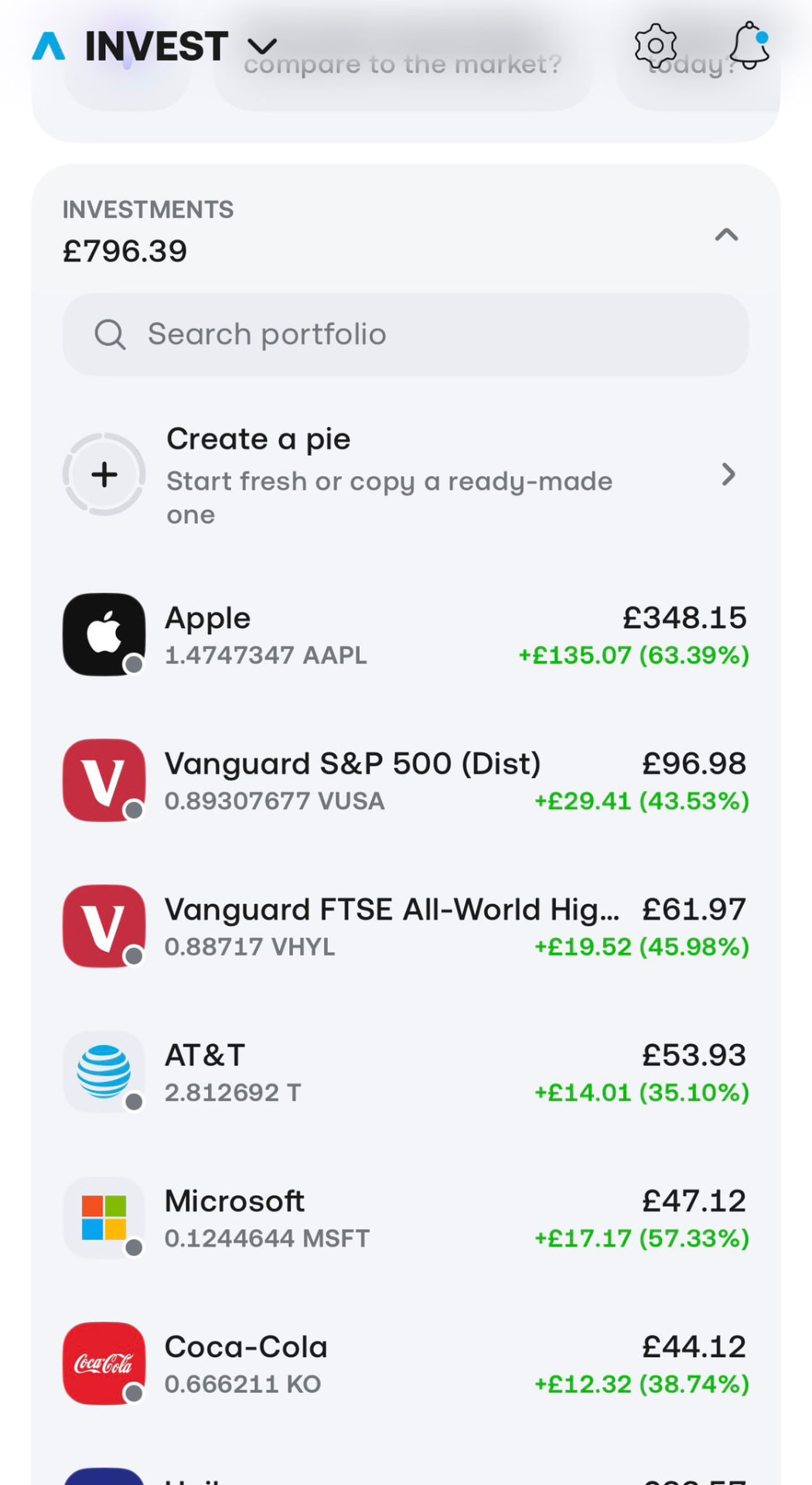
At first glance this looks diversified — six-plus different names, a mix of tech, telecoms, consumer staples, and two Vanguard funds. But diversification isn't really about the number of holdings. It's about how much any single one of them can hurt you if it goes wrong. And by that measure, this portfolio has one obvious soft spot.
The Apple-shaped hole in the diversification story
Apple makes up close to 44% of my entire portfolio. That means nearly half of everything I own rises and falls with the fortunes of one company, in one sector, in one country. If Apple has a bad year — a product flop, a regulatory hit, a broader tech sell-off — it doesn't just dent my portfolio, it defines it.
Compare that to the two Vanguard funds I hold. The S&P 500 fund alone spreads money across 500 US companies; the FTSE All-World High Dividend fund spans thousands of companies globally. Between them they make up only around 20% of my portfolio. In other words, the "safe," broadly diversified part of my investing is currently the minority of my money — the concentrated bet on one stock is the majority.
This is a really common pattern for people who start investing with apps like Trading212. Buying a few well-known companies feels intuitive and exciting in a way that buying "the market" doesn't. But it quietly shifts the portfolio's actual risk profile a long way from what a textbook "diversified" portfolio looks like.
Winning positions aren't automatically safe positions
Every single line in my portfolio is up — some substantially, like Apple's +63% and Microsoft's +57%. It's tempting to read a green screen as evidence of a sound strategy. But strong recent performance and safety are different things:
- A concentrated position that's up 63% is still a concentrated position. The gain doesn't reduce the underlying risk; if anything, unrealised gains sitting in one stock represent more capital exposed to that single company than when I first bought in.
- Everything going up together can mask correlation risk. Apple, Microsoft, and to a lesser extent AT&T are all sensitive to similar macro forces — US interest rates, tech sentiment, the dollar. A "diversified-looking" list of names can still move as one block in a downturn.
- Past performance says nothing about what happens next. Two good years is a short sample size in market terms.
So what would "safer" actually look like?
There's no single definition of a safe portfolio — it depends on your time horizon, how much volatility you can stomach, and what the money is for. But a few general principles are worth holding this portfolio up against:
- Position sizing. Many long-term investors aim to cap any single stock at somewhere around 5–10% of a portfolio, precisely so no one company's bad quarter can do outsized damage. At 44%, Apple is well outside that range.
- Broad, low-cost index funds as the core. Funds like the S&P 500 tracker already in this portfolio are, structurally, one of the more resilient ways to hold equities long-term — you're not betting on any one company surviving and thriving.
- Diversification across geography and sector, not just company count. Six holdings that are mostly US large-cap tech and consumer brands isn't the same as genuine diversification across regions and industries.
- Cash or lower-volatility assets for anything you might need soon. A 100%-equities portfolio, however diversified, is not "safe" in the sense of capital protection over short horizons — it's built for time, not stability.
- Remembering that "no loss yet" isn't the same as "no risk." Two years of gains is a good outcome, not proof of a low-risk approach.
The honest answer
Is this the safest way to invest? Not quite — and the reason isn't the app (Trading212 is just the platform; it doesn't create or reduce risk on its own), it's the shape of the portfolio sitting inside it. Nearly half the money is riding on a single company. That's a legitimate strategy if it's a deliberate, sized bet someone is comfortable with — but it isn't the same thing as a diversified, defensively built portfolio, and it's worth being clear-eyed about which one this actually is.
The good news is the fix doesn't require abandoning the individual stocks — it's mostly a question of proportion: letting the broad index funds become a bigger share of future contributions, so no single company can single-handedly decide how the whole portfolio performs.
This article reflects one investor's personal portfolio and general investing principles — it isn't personalised financial advice. Investment value can fall as well as rise, and past performance doesn't guarantee future results. If you're unsure how to structure your own portfolio, it's worth speaking to a regulated financial adviser.
Some links on this site may be affiliate links, meaning we earn a small commission at no extra cost to you. This never changes what we recommend. Read the full disclosure.
Related articles
How Much Money Do I Need to Retire? A Complete Guide for 2026
How to estimate your retirement number, from the 25x rule and age-based benchmarks to inflation, healthcare costs, and the State Pension.
10 min read →How to Start Investing in the UK: A Beginner's Guide
The first steps into investing without jargon, from choosing your ISA to building a simple index fund portfolio.
8 min read →Side Hustles That Pay in 2026
Realistic ways to earn extra money outside your main job, tested by people who actually do them.
7 min read →